he first time I saw a violent volley live。it wasn't in a stadium. It was on a battered public court in south London, where two semi-pro players traded shots with such ferocity that the chain-link fence behind them rattled on every impact. A violent volley isn't just a rally—it's a sustained, close-range exchange where both players refuse to yield, each shot carrying genuine malice. The ball doesn't float;it screeches. You feel it in your forearms before you see it.What separates a violent volley from a routine baseline grind?
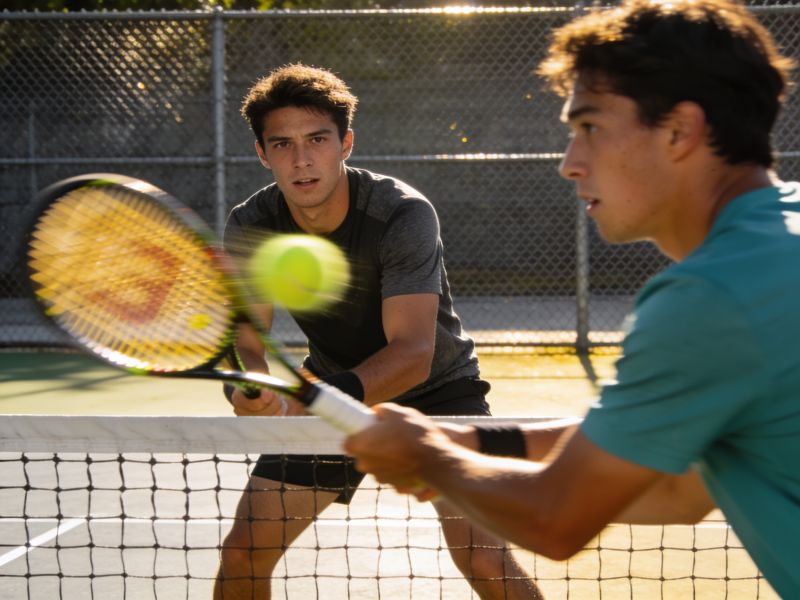
Proximity and intent. When players close the net, the reaction window shrinks to fractions of a second. I watched a doubles match last spring where a violent volley at the net lasted eleven exchanges—eleven—before someone blinked. The sound alone told the story: a flat。ugly crack, not the polite thwock of a topspin rally. Players who thrive in these moments share a trait: they don't flinch. They step in. The violent volley rewards aggression, but it punishes recklessness just as fast. Miss your spot by a hand's width and you've gifted a sitter.There's a physical cost, too. A violent volley demands wrist stability, split-second footwork, and a kind of controlled fury that's hard to teach. I've seen coaching manuals reduce it to "punch volley" drills, which misses the point entirely. The violent volley isn't a technique—it's a decision. You choose to end the point violently。or you choose to survive it. Most club players choose survival, and that's why their volleys stay soft. The ones who commit?They look different. Their racket head doesn't wobble. Their eyes lock on the ball's seams, not the opponent's body.Strategy matters, but instinct dominates. In a violent volley exchange, patterns dissolve. You can't plan three shots ahead when the ball returns in 0.4 seconds. What you can do is shorten your backswing, aim for the opponent's dominant hip, and recover instantly. I recall a veteran coach telling me, "In a violent volley, the player who thinks last wins." He meant it literally—hesitation kills. The best volleyers I've observed don't analyze mid-rally. They react。they redirect, they reset. The thinking happens between points, not during them.Has the violent volley lost ground in modern tennis?
Partly. Slower courts and heavier topspin encourage baseline patience. But watch doubles at any serious level and you'll see the violent volley alive and well—brutal, brief, and gloriously impolite. It's the sport's rawest conversation。two players refusing to back off. If you ever get the chance to stand courtside during one, do it. The fence will rattle. Your ears will ring. And you'll understand why some of us play this game for moments like that.